Author: Rob Goldstein

  • Big Wins for Conservation Funding in 2025

    Big Wins for Conservation Funding in 2025

    Election Day 2025 delivered some good news for the field of nature conservation. It was a welcome break in an otherwise brutal year marked by deep federal funding cuts.

    Voters approved 33 local ballot measures across 10 states that will generate over $2 billion in public funding for conservation and parks over the next 20 years. 

    What We Tracked

    We tracked 35 local ballot measures across ten states. 

    • 25 conservation funding measures — every one we could identify.
    • 10 park-district measures that support systems with significant natural areas.

    In the end, 33 ballot measures passed. That is a 94% win rate for conservation and parks. 

    To calculate total funding, we used Trust for Public Land’s LandVote Database to fill in gaps in publicly available data.

    Nation at a glance

    • Total conservation dollars approved: $777 million
    • Total park dollars approved: $1.32 billion. A portion goes to conservation (natural area stewardship, trail building, outdoor education, etc) 
    • Measures passed: 33 wins / 2 losses
    • Funds support: Open space acquisition, land stewardship, trail construction, education programs, park operations, park  improvements, education programs.

    [subscription]

    State-by-State Results

    Colorado

    Fort Collins – Natural Areas Sales/Use Tax — WIN (72%)
    $181,051,760 • Open-space acquisition, habitat restoration, operations, and maintenance. 

    Boulder County – Open Space Sales & Use Tax — WIN (73%)
    $150,000,000 • Acquisition, stewardship, trails.

    Denver – Parks & Recreation Bond — WIN (66%)
    (Parks measure – partial conservation funding)
    $174,750,000 • Capital improvements for parks and recreation facilities.

    Connecticut

    All fund open-space acquisition.

    South Windsor – Open Space Bond — WIN (74%)
    $2,000,000

    Cheshire – Open Space Bond — WIN (72%)
    $1,500,000

    Southington – Open Space Bond — WIN (62%)
    $2,000,000

    Idaho

    Boise – Clean Water & Open Space Levy — WIN (81%)
    $11,000,000 • Two-year levy for open-space acquisition, water-quality projects, recreation, restoration, and wildfire mitigation.

    New Jersey

    All focus on levies (property tax add-ons) for open space trust funds that pay for open space acquisition and stewardship.

    Sussex County – Open Space Measure  — WIN (81%)
    $3,950,000 • Renews existing levy.

    Stillwater – Open Space Measure — WIN (61%)
    $122,739 • Establishes new levy and trust fund.

    White Township –  Open Space Measure — WIN (54%)
    $3,328,309 • Increases existing tax. 

    Mount Laurel  – Open Space Measure — WIN (71%)
    $46,896,180 • Renews existing levy.

    Morristown – Open Space Measure — WIN (72%)
    $7,976,807 • Establishes new levy and open space trust fund.

    South Orange – Open Space Measure — WIN (70%)
    $8,560,000 • Increases existing levy.

    Monmouth County – Open Space Measure — WIN (67%)
    $253,799,940 • Increases existing levy.

    Ridgewood – Open Space Measure — WIN (59%)
    $6,060,000 • Increases existing levy.

    Manasquan – Open Space Measure— WIN (64%)
    $8,338,329 • Increases existing levy.

    Alpine – Open Space Measure — WIN (78%)
    $993,080 • Renews existing levy.

    Demarest – Open Space Measure — WIN (70%)
    $2,778,040 • Renews existing levy.

    Oradell –  Open Space Measure  — FAILED (39%)
    $3,608,535  • Establishes new levy and open space trust fund.

    Little Silver – Open Space Measure — WIN (61%)
    $2,317,830 • Increases existing levy.

    Westhampton – Open Space Measure — WIN (83%)
    $4,802,860 • Renews existing levy.

    New Mexico

    Parks Measure (partially funds nature conservation)

    Albuquerque – Bonds for Parks and Recreation) — WIN (55%)
    33,800,000 • Bond for city park improvements. Includes $4.9 million for open space acquisitions, $400,000 for urban forestry, and $500,000 for environmental education.

    New York

    Rochester – Community Preservation Plan & Tax — WIN (59%)
    $6,683,660 • The Community Preservation Fund (CPF) is funded by a real estate transfer tax. Supports farmland, water and open space conservation.

    Ohio

    Parks Measures (partially fund nature conservation)

    Medina County Park District LevyWIN (55%)
    $67,000,000 • Park levy renewal.

    Lake Metroparks Levy WIN (67%)
    $116,733,610 • Park levy renewal.

    Geauga Park District Levy WIN (50%)
    $3,384,359 • Park levy renewal and increase.

    Ashland County Park District LevyWIN (52%)
    $1,300,000 • Park levy renewal and increase.

    Canton Parks & Recreation LevyWIN (65%)
    $31,900,000 • Five year replacement levy.

    Great Parks of Hamilton County Levy — WIN (75%)
    $202,652,550 • 10-year renewal levy.

    Oregon

    Parks Measure (partially funds nature conservation)

    Portland Parks & Recreation Levy WIN (55%)
    $456,000,000 • Five year levy.

    Pennsylvania

    All focused on taxes (income tax add-on) to pay for open space acquisition and stewardship.

    Upper Providence Township – Open Space MeasureFAILED (41%)
    $20,000,000 • Creates a new tax to pay for open space.

    Upper Frederick Township – Open Space Measure  — WIN (73%)
    $1,180,000 • Increases existing tax.

    South Whitehall Township – Open Space Measure  — WIN (74%)
    $20,000,000 • Increases existing tax.

    Williams Township – Open Space Measure — WIN (62%)
    $8,000,000 • Increases existing tax.

    Washington

    Parks Measure (partially funds nature conservation)

    Spokane City Parks LevyWIN (55%)
    $240,000,000 • 20-year levy.

  • Layoff Plan Targets Ecological and Wildlife Research Workforce

    Layoff Plan Targets Ecological and Wildlife Research Workforce

    Trouble is brewing for federal wildlife and ecological workers. 

    Court filings reveal the administration’s intention to fire 2,050 workers at the Department of Interior. The cuts are on hold for now after a temporary court order. But the threat remains very real.

    Most worrying, the planned layoffs would devastate USGS Ecosystems Mission Area – the backbone of ecological research in the United States. 

    See our tracker entry: The Dismantling of USGS Ecosystems Mission Area

    Congress could potentially avert this. As the shutdown negotiations continue, senators could demand that Congress assert authority over federal workforce reductions – ensuring that no administration can unilaterally carry out mass layoffs of career scientists and conservation staff without Congressional oversight.

    According to Interior’s October 20 court filing, the plan would eliminate roughly 28 percent of the Ecosystems Mission Area workforce, with deep cuts at major research centers:

    108 layoffs (79% cut) — Great Lakes Science Center

    80 layoffs (78% cut) — Columbia Environmental Research Center

    56 layoffs (75% cut)  — Climate Adaptation and Science Centers

    39 layoffs (57% cut) — Fort Collins Science Center

    28 layoffs (40% cut) — The Northern Prairie Wildlife Research Center

    Other conservation agencies are also targeted:

    Bureau of Land Management 475 layoffs 

    National Park Service 272 layoffs

    US Fish and Wildlife Service 143 layoffs

  • Conservation Jobs Fall Sharply in 2025

    Conservation Jobs Fall Sharply in 2025

    Summary

    The conservation workforce includes the people and organizations that protect, manage, and study nature. These are the jobs responsible for our parks, forests, wildlife, and water resources.

    To understand trends in conservation hiring in the United States, we analyzed job posting data from 2025, 2024, and 2023. We also surveyed 337 conservation employers in March–April 2025 about expectations and reasons for changes in hiring. 

    We found that non-federal conservation hiring in the United States began to collapse by mid-February 2025.

    From March 1–September 30, 2025, postings on Conservation Job Board fell 29.4% year over year (YOY). This was a sudden downturn. Total postings in 2024 increased 5.4% YOY. 

    These include jobs with state and local agencies, nonprofits, universities, and private-sector employers. This count also includes non-federal jobs that work in partnership with federal agencies, such as conservation corps and nonprofit partners. Altogether, they represent the majority of the conservation workforce.

    Postings have fallen more sharply for federal jobs. However, the low volume of federal listings on third-party sites such as Conservation Job Board makes year-to-year comparisons less reliable.

    Results

    A Stable 2024 Turned into a 2025 Collapse
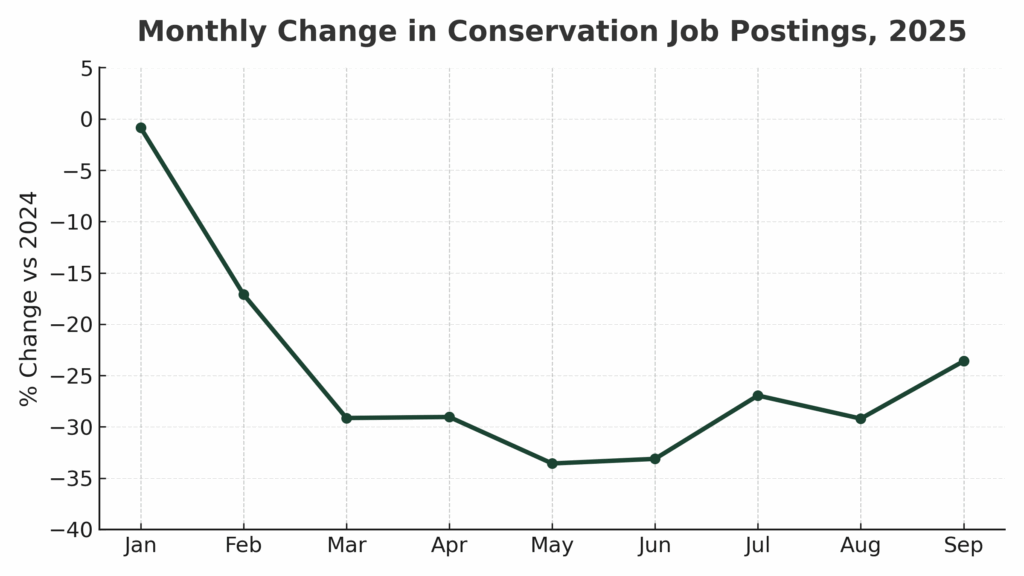
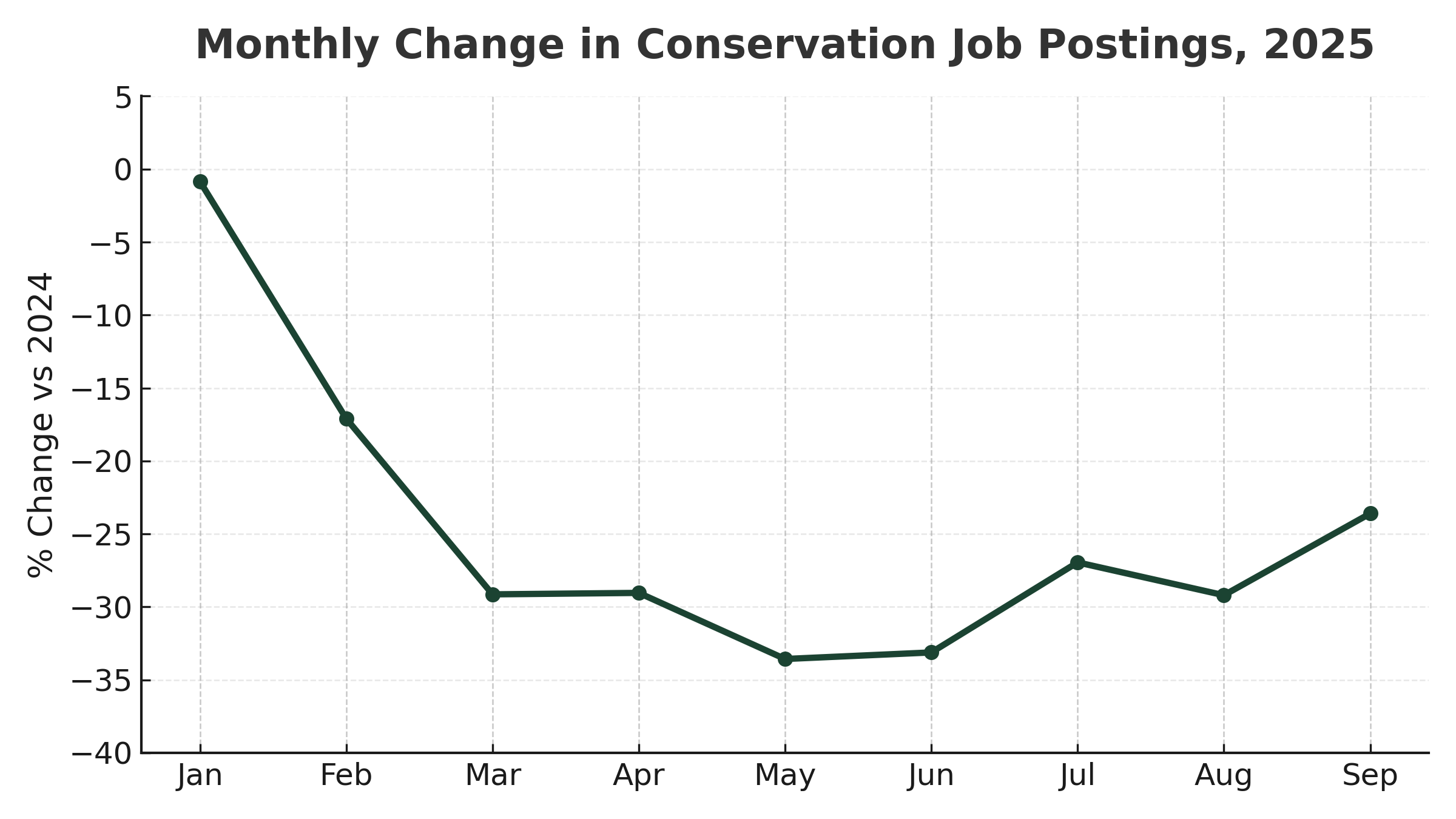
    Figure 1. Monthly change in conservation job postings, 2025. — Source: Conservation Job Board internal analytics.

    The 2025 hiring decline was not only sharp but also sudden. Conservation Job Board data show a relatively stable job market in 2024, with total postings increasing 5.4% YOY to 15,991 listings. 

    Postings for non-federal jobs fell 0.8% in January 2025. In February, postings fell 17%. In March, they fell 29%, and the decline continued through the summer, hovering around a 30% YOY drop. The decline moderated slightly to 23.6% in September. However, preliminary October data suggest the downturn is not yet reversing.

    We suspect that the figures from January and February understate the level of hiring decline in those months. We received some reports from employers about jobs posted in January and February that were ultimately canceled or delayed due to federal funding freezes and uncertainty.

    Jobseeker Competition Heats Up
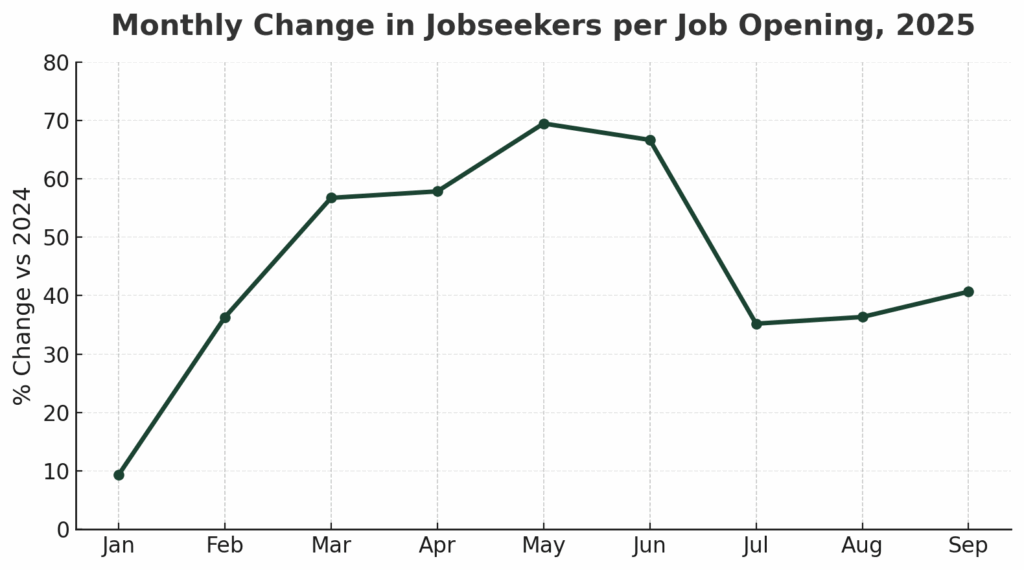
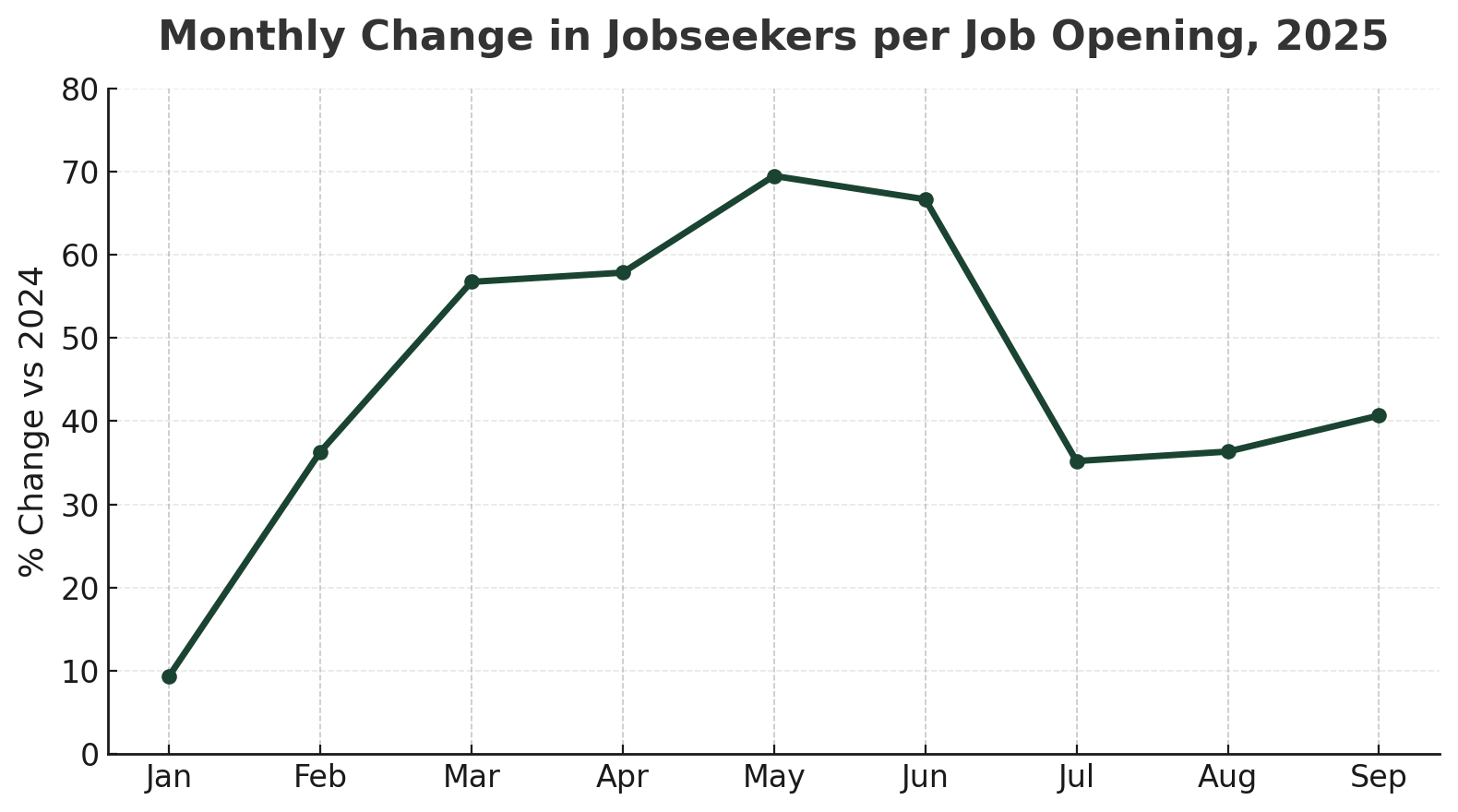
    Figure 2. Monthly change in jobseekers per job opening, 2025. — Source: Conservation Job Board internal analytics.

    Jobseeker competition has surged. Average monthly jobseeker traffic increased 7.7% in 2025. However, we assess job-search competitiveness by comparing the number of jobseekers to job openings. The jobseekers-per-job ratio increased 40% for the period of January–September.

    Job-search competitiveness:
    • 84 jobseekers per job opening in 2024
    • 117 jobseekers per job opening in 2025

    The YOY increase in job-search competitiveness peaked from March–June. This period saw the steepest declines in hiring along with the largest increases in traffic. This pattern likely reflects a lag between the federal funding freeze imposed in January and February and its full effect on seasonal hiring and job search, which normally peaks from January–April for the summer field season. Federal layoffs in February likely intensified jobseeker competition further.

    Breakdown by Job Type and Key Trends

    We examined how different job types fared during the period of steepest decline: March 1-August 30 (2025 vs. 2024).

    % Changes by Job Type:
    • Permanent Jobs -32.8%
    • Seasonal/temporary Jobs -15.8%
    • Paid internships -43.8%
    • AmeriCorps -42%

    Paid internships and AmeriCorps positions suffered the biggest losses. These are critically important pipelines for early-career development in conservation.

    Permanent jobs are typically full-time positions with benefits and no defined end date. These are the secure roles that professionals rely on for a stable livelihood. Seasonal and temporary jobs tend to offer lower pay, fewer (or no) benefits, and less stability. However, they have long played an important role in conservation due to the short timeframes of project fieldwork and the need to staff up parks during peak visitation periods.

    The relative performance of these job types suggests that employers are increasingly relying on seasonal workers over permanent staff to meet operational needs. This trend is problematic for worker livelihoods and the viability of conservation as a career pathway.

    Signs of Federal Decline but Uncertain Figures

    Most conservation hiring happens with non-federal employers—state and local agencies, nonprofits, universities, and the private sector. Nevertheless, the federal government is the single largest employer in conservation. 

    Yet, federal hiring trends are harder to analyze.  Most federal jobs are posted exclusively on USAJOBS rather than third-party sites such as Conservation Job Board. Furthermore, recruiting practices may have shifted under the new administration, given its major operational changes.   

    The data suggest that federal hiring declined sharply in 2025: federal postings to Conservation Job Board fell roughly 60%. However, because federal postings are a small share of total listings (less than 5%), direct comparisons between 2024 and 2025 are less reliable.

    Cautious Employer Outlook

    In March and April 2025, we surveyed 337 conservation employers about their hiring expectations for the rest of the year. Their responses indicate that caution has taken hold.

    Employer expectations for 2025 hiring:
    • 42% expected to hire fewer people than the same period in 2024.
    • 35% expected to hire the same number.
    • 16% expected to hire more. 
    • 8% weren’t sure.

    Organizations expecting to reduce hiring in 2025 outnumbered those expecting to increase hiring nearly 3:1. This suggests that the hiring slowdown will persist through the remainder of the year.

    In our survey, employers were asked to give reasons for expected changes in hiring.

    The most common employer reasons for expected declines:
    1. Reduced or uncertain federal funding
    2. The general state of the economy and rising costs
    3. Leadership caution

    [subscription]

    Discussion

    Exploring the Causes of the Hiring Downturn

    Below, we explore why the conservation job market has been collapsing. The employer responses from our survey and the timing of the sharp decline in job postings point to likely causes.

    DOGE Impacts

    The timing of the hiring downturn lines up with the Trump administration’s newly created Department of Government Efficiency (DOGE) and its early policy shifts. 

    In January 2025, DOGE began freezing billions of dollars in environmental and research grants. The freeze directly affected a wide range of non-federal conservation employers that had been awarded grants and were relying on them for hiring. Within weeks, the freeze expanded into widespread, long-term delays—and in many cases outright cancellations—of funding that Congress had already approved.

    In April, the cuts spread to AmeriCorps, including its conservation programs, where thousands of members were terminated mid-service. Field crews were pulled from restoration, trail building, and education projects nationwide.

    Together, these disruptions likely played a major role in the decline of conservation hiring in 2025.

    State of the Economy

    The broader economic environment likely contributed to the decline in new conservation jobs. Conservation employers cited rising costs, economic uncertainty, and leadership caution as reasons for expected changes in 2025 hiring. Furthermore, these trends have coincided with a downturn in the broader labor market nationally.

    Federal Hiring Impacts

    While our data review focuses primarily on non-federal employers, the hiring collapse clearly extended into the federal conservation workforce. The administration froze hiring across multiple agencies, including the National Park Service, U.S. Fish and Wildlife Service, and U.S. Forest Service. 

    Some seasonal hiring appeared to resume by March. However, an analysis of Department of Interior internal data found that the administration was falling well short of its seasonal staffing goals. 

    Anecdotal reports have proliferated: seasonal rangers never got callbacks; research fellows saw their start dates “postponed indefinitely.” Many of those jobs likely vanished.

    Why it Matters

    Nature Conservation is a Workforce

    Nature conservation provides wide-ranging benefits to society. It means parks, outdoor recreation, healthy wildlife, clean water, sustainable natural resources, and public safety from fires and flooding. But it takes a workforce to make conservation happen. A collapse in hiring, coupled with federal layoffs, threatens those benefits and services.

    News reporting and surveys give us glimpses of the impacts: a struggling National Park System, disruption to ecological research, cancellation of habitat restoration projects, and termination of trail building and maintenance crews.  

    A 30% decline in conservation hiring means this is just the tip of the iceberg. 

    Conservation Employment Fuels Local Economies

    Conservation jobs provide livelihoods for tens of thousands of Americans, from trail builders and wildlife biologists to park planners and lab technicians. A decline in conservation hiring means increased hardship and struggle for people.

    The field of conservation is the cornerstone of a multibillion-dollar, outdoor recreation and tourism sector. For example, National Parks visitors contributed $29 billion in spending to local communities in 2024, supporting 340,000 jobs. Cuts to conservation put the entire outdoor recreation and tourism sector at risk. 

    The Erosion of Expertise and the Future Workforce

    The cuts to conservation are hitting both ends of the professional ladder. Early-career pipelines are disappearing. AmeriCorps positions and internships have fallen more than 40 percent. These are important pathways for conservation professional development. 

    Meanwhile, layoffs and attrition at federal agencies are erasing decades of expertise. These are the specialists who manage our national parks. These are the experts who run complex programs to save endangered species.

    Together, these losses could lead to a void in leadership and skills that could take years to recover. 

    Closing Thought

    Conservation hiring isn’t just a labor statistic. It’s a measure of how seriously the United States is investing in its land, water, wildlife, and communities. When conservation jobs disappear, so does our capacity to protect, manage, and study nature.

    Methods

    Understanding the State of the Conservation Job Market

    Conservation Job Board provides a lens for understanding annual hiring trends in the field of nature conservation. The site was launched in 2010 and offers free job postings to employers. Now 15 years old, it reaches a large, stable audience of job seekers and employers, broadly covering the extent of the field. In 2024, it received 15,991 total job postings. The website has not undergone any major changes in design, functionality, or marketing since January 1, 2023. 

    We believe that changes in job posting volume on the website can indicate hiring trends in the field. Posting volume can also change for unrelated reasons (e.g., business performance), but if those factors were the drivers, we would expect a corresponding shift in total audience reach. To control for that, we also examined trends in total website visitors.

    Methodology

    We measured the monthly volume of US-based jobs posted on Conservation Job Board in 2023, 2024, and 2025 (through September 30, 2025). To understand trends in hiring, we calculated YOY percent change in 2024 and 2025 by month.

    To see how trends varied across the field, we repeated measurements for: a) federal vs. non-federal jobs; and b) permanent, seasonal, internship, and AmeriCorps positions.

    We also measured monthly and total U.S.-based website users in 2024 and 2025 and calculated the percent change from 2024 to 2025. The total number of users grew ~2%, suggesting that business factors were unlikely to be driving major changes in posting volume. We therefore did not adjust the posting data for business effects.

    We then assessed trends in job search competitiveness by calculating jobseekers per posting for 2024 and 2025.

    Lastly, to inform our understanding of the motivations behind trends, we reviewed results from a survey conducted in March–April 2025 from 337 conservation employers. The survey asked about expected hiring for the remainder of 2025 and the factors influencing any changes.

    About the Authors

    Rob Goldstein founded Conservation Job Board in 2010 and Works for Nature in 2025. He holds an M.S. in Human Dimensions of Natural Resources from Colorado State University and has worked in the conservation field for over 20 years.

    Swapnika Gupta and Kouceyla Hadji assisted with data collection and analysis.
  • Changes Proposed for Land and Water Conservation Fund

    Changes Proposed for Land and Water Conservation Fund

    In June we began tracking proposed changes to the Land and Water Conservation Fund (LWCF).

    As a refresher, the LWCF is the single most important source of funding for conservation projects in the US. The money largely goes to land acquisitions that, at the state level, create new parks and open space and, at the federal level, expand our public lands.

    It was set up by Congress to take some of the proceeds from offshore oil and gas royalties and put it back into conservation. In 2020, Congress permanently funded the LWCF at $900 million / year. 

    In our tracker, we initially titled the entry: Defunding of the LWCF. This is because the administration had proposed diverting $387 million of funding from the LWCF to use for other purposes. 

    But a federal order issued by the Department of the Interior on September 4 shows the administration’s shifting strategy with the LWCF.  

    The order makes no mention of the diversion of funding. It appears that the administration has abandoned this idea for now. 

    This is a bit of a surprise. It was reported by the Washington Post in August that this forthcoming order would include language diverting LWCF funds. However, key Republican senators have recently made public statements in defense of the LWCF. The fund enjoys broad bipartisan support. Perhaps this is what prompted the administration to change course for now. 

    Instead the administration is pursuing other strategies to subvert the LWCF. The Department of Interior’s order contains several problematic directives.

    First, it restricts new land acquisitions for the Bureau of Land Management. This will mean fewer potential projects. 

    Second, the order requires that the state governor and local government leadership sign off on any acquisition projects. This adds hurdles to already complex acquisitions. And it will also likely reduce the number of completed projects. 

    Lastly, the order authorizes state recipients of LWCF funding to purchase federal surplus property. It is unclear how this will be implemented. But it appears to open the possibility for back door public land sales.

  • Roadless Rule Repeal Draws 625K Public Comments

    Roadless Rule Repeal Draws 625K Public Comments

    Hopefully you got your comment in before the clock struck 11:59 pm. The initial public comment period for the Trump administration’s plan to rescind the 2001 Roadless Area Conservation Rule officially closed on September 19, 2025.

    The Federal Register is currently showing 625,737 total comments received. This is a big number for an initial public comment period — especially considering the short 21-day window. The norm for a rule of this magnitude is 60 days.

    Conversely, the adoption of the Roadless Rule in 2001 was a 15-month process with 600 community meetings and 1.6 million total comments received – a record for the US Forest Service. In the current process, the administration is clearly trying to limit public input. Nevertheless, with one more required public comment period to come, the total comments could surpass the 2001 figure.

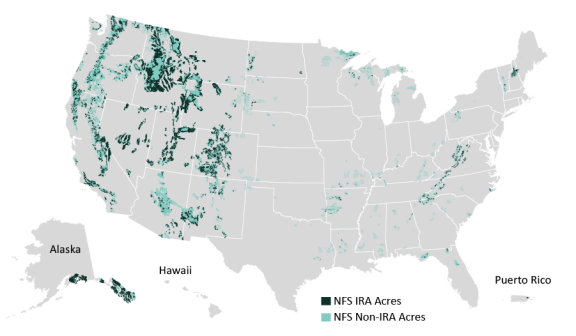
    People are clearly concerned about the administration’s plans. Rescinding the rule could open 58.5 million acres of national forest to new roadbuilding, logging, and mining.
    A wide range of stakeholders have lined up in opposition. Conservation nonprofits, hunting groups, local municipalities, and Native American tribes have all spoken out against rescinding the Roadless Rule.

    A comment-analysis by Center for Western Priorities found over 99% of early commenters opposed the repeal of the Roadless Rule.

    Next, the Department of Agriculture will review comments and prepare a Draft Environmental Impact Statement (EIS) and proposed rule, expected in early 2026. This will trigger a 2nd public comment period before USDA finalizes its analysis.

    A final EIS and Record of Decision is projected for release in late 2026, when the administration will decide whether to fully rescind the Roadless Rule or adopt a modified approach. We will keep you posted.

  • House Advances Spending Bill that Makes Deep Cuts to AmeriCorps

    House Advances Spending Bill that Makes Deep Cuts to AmeriCorps

    The future of AmeriCorps comes down to 2 spending bills in the House and the Senate for Fiscal Year 2026.

    What Happened

    The Senate did its part. On July 31, with a 26 – 3 bipartisan vote, the Appropriations Committee advanced a spending bill that fully funds AmeriCorps at 2025 levels.

    But House Republicans turned their backs on AmeriCorps.

    On September 2, the House subcommittee approved a bill along party lines that cuts AmeriCorps funding by roughly 50%. If enacted, this would eliminate tens of thousands of AmeriCorps service positions.

    The House bill also renames “AmeriCorps” as “America First Corps.” Meanwhile it makes drastic cuts to most AmeriCorps programs including AmeriCorps State and National, NCCC, VISTA, the Foster Grandparent Program, and the Senior Companions Program. The bill makes a whopping 75% cut to the National Service Trust — which pays for education awards to AmeriCorps members.

    This follows the administration’s failed effort to dismantle AmeriCorps. In April, DOGE tried this without Congress — i.e. illegally — when it cancelled $400 million in AmeriCorps funding, terminated 32,000 service members, and laid off 85% of AmeriCorps agency staff.

    The courts partially blocked these acts. But now, House Republicans have taken matters into their own hands.

    Why This Matters

    These cuts would harm the conservation workforce. AmeriCorps volunteers serve in critical roles with public land agencies and nonprofits.

    They build and maintain our nation’s trail systems. They reduce wildfire risk and control invasive species. They staff our parks and educate our kids.

    This would also hurt local communities where AmeriCorps volunteers provide critical support in disaster response, public health and education.

    When the administration tried to dismantle AmeriCorps last spring, local communities expressed anger especially in red states. See:

  • Court Ruling Strips Endangered Status From Lesser Prairie-Chicken

    Court Ruling Strips Endangered Status From Lesser Prairie-Chicken

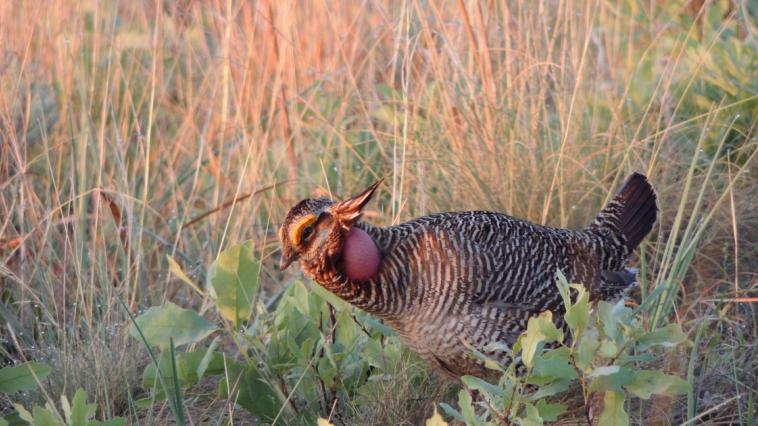
    On August 12, a federal judge in Texas stripped the lesser prairie-chicken of Endangered Species Act (ESA) protection. This is a major setback for the conservation of this Southwestern bird, famous for its elaborate mating rituals.

    The southern population of the bird had been listed as endangered in New Mexico and parts of Texas. The northern population had been listed as threatened in Colorado, Kansas, Oklahoma, and other areas of Texas.

    It’s been a tough road for the lesser prairie-chicken.

    The lesser prairie-chicken has lost approximately 85% of its habitat and its population has declined roughly 97% since 1800. The bird has now been listed and delisted under the ESA multiple times due to lawsuits.

    US Fish and Wildlife Service under the Biden administration listed the lesser-prairie chicken under the ESA in 2022. The states of Texas and energy industry groups filed suit against the federal government to contest the designation.

    But with a new president in the White House, the Department of Interior made an unusual move of asking the judge to rule against it. Judge David Counts of the Western District of Texas sided with the Trump Administration’s claim that the Service’s decision was built on a “serious defect” in its analysis and legal justification.

  • Judge Blocks the Opening of Pacific Marine Monument to Fishing

    Judge Blocks the Opening of Pacific Marine Monument to Fishing

    A federal judge in Hawaii blocked the Trump administration from opening the Pacific Islands Heritage Marine National Monument to commercial fishing.

    In April 2025,  Trump issued an Executive Order for the National Marine Fisheries Service to open the protected area to commercial fishing. On May 22, Earthjustice filed a lawsuit on behalf of Kāpaʻa, the Conservation Council for Hawai‘i, and the Center For Biological Diversity.

    According the US Fish and Wildlife Service:

    The Monument is home to one of the largest and most pristine collections of tropical islands, coral reef, seamounts and deep sea protected areas on the planet.

    Judge Micah WJ Smith ordered the regulations banning commercial fishing to remain in place. The judge agreed with the plaintiffs that the Trump administration broke the law by changing federal rules without going through the legally required public comment process.

    According to Solomon Pili Kaho’ohalahala, Founding Member of Kāpaʻa

    The Fisheries Service cannot ignore our perspectives as the native people who belong to the islands and to the ocean that surrounds us. The law guarantees a process where we can advocate for protecting the generations of our children’s children who are yet to be born.

  • Administration Looks to Divert Money From Conservation Fund

    Administration Looks to Divert Money From Conservation Fund

    The Washington Post reports that the administration is drafting an Executive Order divert money from the Land and Water Conservation Fund (LWCF)—money that was approved by Congress for acquiring new land for national parks and wildlife refuges.

    See our tracker entry: Defunding Land and Water Conservation Fund.

    The LWCF was established by Congress to use the revenue from oil and gas royalties—not taxpayer money—to acquire high-priority conservation land. The Great American Outdoors Act—signed by Trump himself in 2020—permanently funds the LWCF at $900 million / year.

    However, Trump wants to divert that money to pay for long-overdue park repairs. But paying for park repairs should come from the annual federal budget. In fact the Great American Outdoors Act explicitly forbids using the money for this purpose.

    The 3-Pronged Attack on Public Land Acquisition: 

    This is all part of a 3-pronged attack the adminstration is waging on the Land and Water Conservation Fund.

    In a parallel approach, the administration is trying to divert LWCF money via Congress. Trump submitted a budget request to Congress to divert $253 million from the LWCF for park repairs. So far, Congress has rejected Trump’s funding cuts in its spending bills.

    Lastly, The Washington Post article outlines a 3rd approach—willful neglect. The Department of the Interior has not sent Congress a list of proposed purchases for 2026. In other words, the administration is choosing to ignore its duties in spending LWCF money.

  • Senate Appropriations Bill Maintains Funding for AmeriCorps

    Senate Appropriations Bill Maintains Funding for AmeriCorps

    The Senate delivered some good news for Americorps. The appropriations committee approved a spending bill that funds AmeriCorps at close to FY2025 levels. This means we’re a step closer to saving thousands of service positions every year that protect nature and manage our public lands.

    This is encouraging considering the circumstances. The Trump administration has been trying to dismantle Americorps. Trump proposed eliminating  AmeriCorps entirely in his 2026 budget request. Thankfully, the Senate, in bipartisan fashion, rejected Trump’s extreme cuts.

    Voices for National Service, the leading advocate specifically for AmeriCorps, expressed optimism after the outcome.  According to President AnnMaura Connolly:

    We’re encouraged by the Senate Appropriations Committee’s bipartisan agreement to protect AmeriCorps funding. It’s a positive signal, and we deeply appreciate Chairwoman Capito and Ranking Member Baldwin’s leadership in securing that support.

    However, this is just one step in a long appropriations process. Next step: the House will release their spending bill for AmeriCorps. And these bills will then need to be approved by the full chambers, reconciled with each other,  and signed by the president. So it’s a long road ahead.